
Other Chiral Phases
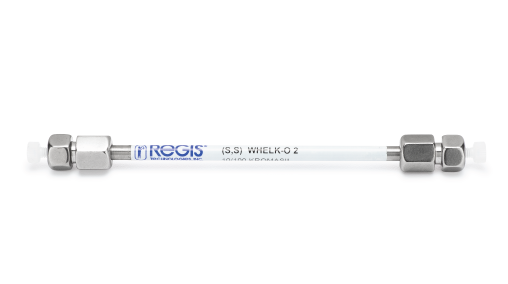
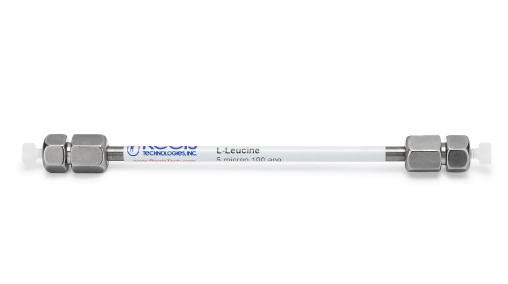
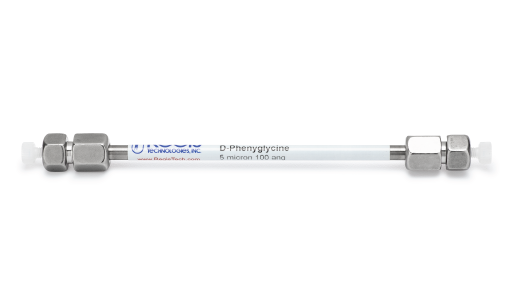
With nearly 50 years of experience in developing Chiral Stationary Phases (CSPs), Regis offers an exclusive line of brush-type (sometimes called Pirkle-type) chiral columns. Designed in partnership with Professor William Pirkle, the following eight phases offer a range of selectivity and distinct advantages for broadening your screening library.
Advantages of the Pirkle-Type Chiral Stationary Phases:
- Excellent method development columns with applicability to a wide range of compound classes
- Alternate selectivity to polysaccharide chiral stationary phases
- Covalently bonded for long-term performance and broad mobile phase compatibility
- Broad range of particle sizes and dimensions for analytical to preparative scale separations
- High loading capacity for excellent scalability in preparative applications
- Choice of enantiomeric phases enables inversion of peak elution order
The entire family of Regis’ Pirkle-Type chiral stationary phases can be used for HPLC or SFC applications and are compatible with both normal- and reversed-phase solvents. Since all of the Pirkle-Type CSPs are covalently bonded, the columns can tolerate all commonly used mobile phase combinations and are very durable. All of the Pirkle-Type CSPs are available in both enantiomeric forms. This allows the chromatographer to invert the elution order of the enantiomers by simply switching columns. This feature is helpful in determining enantiomeric purity when the trace enantiomer should elute before the major one. Elution order can also be important in preparative chromatography applications, because when the desired enantiomer elutes first, purity and production efficiency increases.
Connect with a member of our sales team to request a quote, or click on the buttons below to place an order online.
View our Chiral Applications Database.
Request or download a free copy of our Chiral Handbook that contains more than 950 chiral separations.
Email Us for more information.
Visit our Literature Library to download product information, application notes, and other technical resources.